
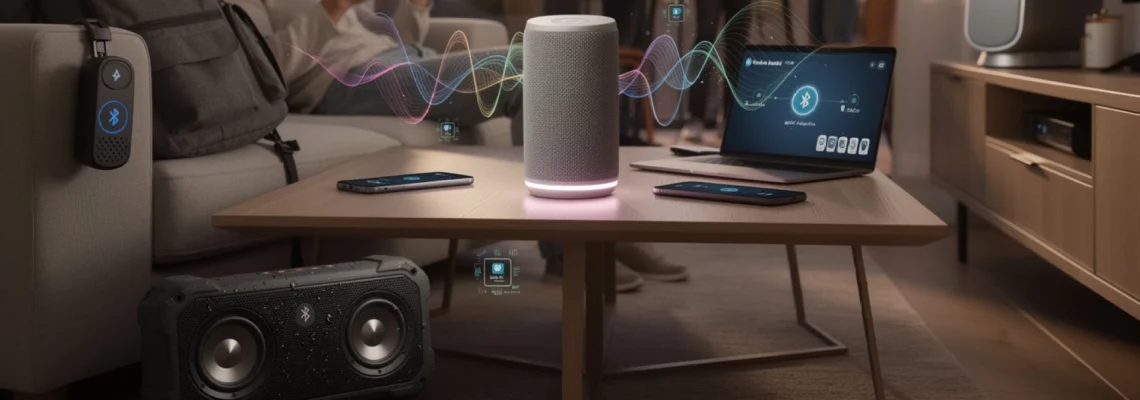
The transformation of how we consume audio content has been nothing short of revolutionary over the past decade. Bluetooth speakers have emerged as the definitive solution for those seeking freedom from tangled cables whilst maintaining exceptional sound quality. Whether you’re preparing breakfast in the kitchen, hosting a garden party, or unwinding with your favourite podcast in bed, these wireless devices have seamlessly integrated into nearly every aspect of modern life. The technology behind these portable powerhouses continues to evolve at a remarkable pace, with innovations in codec technology, battery efficiency, and smart integration fundamentally changing what we can expect from a speaker that fits in the palm of your hand.
Understanding the intricacies of Bluetooth speaker technology isn’t merely an academic exercise—it directly impacts the quality of your listening experience and helps you make informed purchasing decisions. From the codec that processes your audio data to the battery technology that keeps your music playing throughout the day, each component plays a crucial role in delivering the sound you deserve. The sophistication of modern Bluetooth speakers means you no longer have to compromise between portability and audio fidelity, convenience and performance, or style and substance.
Understanding bluetooth codec technology: aptx, LDAC, and AAC performance
At the heart of every Bluetooth speaker lies codec technology—the invisible algorithm that compresses, transmits, and decompresses your audio data. Think of codecs as translators that convert your music from its original digital format into a wireless signal that can travel through the air, then reconstruct it at the other end. The quality of this translation process determines whether you hear every subtle nuance of a classical violin concerto or miss the delicate cymbal work in your favourite jazz recording. Modern codec technology has reached a level of sophistication that challenges even the most discerning audiophiles, with transmission rates and compression techniques that preserve the integrity of high-resolution audio files.
The codec landscape has become increasingly diverse, with different manufacturers championing various proprietary and open-source solutions. Your choice of codec—or rather, the codec supported by your speaker and source device—can mean the difference between acceptable background music and an immersive listening experience that does justice to your carefully curated music library. Understanding these differences empowers you to select devices that work harmoniously together, maximising the audio quality potential of your entire ecosystem.
Aptx adaptive and aptx HD: Low-Latency audio streaming explained
Qualcomm’s aptX family of codecs represents a significant leap forward in Bluetooth audio transmission. The aptX Adaptive codec intelligently adjusts its bitrate between 279 kbps and 420 kbps depending on network conditions and content type, ensuring consistent performance even in challenging wireless environments. This dynamic approach means you’re less likely to experience dropouts or quality degradation when your smartphone receives a notification or when you move through areas with heavy wireless traffic. For those who enjoy gaming or watching videos on their devices, aptX Adaptive delivers latency as low as 80 milliseconds, virtually eliminating the frustrating lip-sync issues that plague lesser codecs.
The aptX HD variant takes a different approach, prioritising absolute audio quality over adaptability by maintaining a consistent 576 kbps bitrate. This higher throughput preserves more of the original audio information, capturing the subtle harmonics and spatial cues that give music its depth and dimension. Many audiophile-grade Bluetooth speakers now incorporate aptX HD support specifically to cater to listeners who refuse to compromise on sound quality, even when embracing the convenience of wireless technology.
Sony LDAC: High-Resolution 990 kbps wireless transmission
Sony’s LDAC codec stands at the pinnacle of Bluetooth audio transmission, achieving bitrates up to 990 kbps—nearly three times the data rate of standard Bluetooth codecs. This exceptional bandwidth allows LDAC to transmit true high-resolution audio wirelessly, supporting sampling rates up to 96 kHz and bit depths of 24 bits. For context, CD-quality audio operates at 44.1 kHz and 16 bits, so LDAC’s capabilities extend well beyond what most commercial recordings offer. The codec has become increasingly prevalent since Sony opened it to third-party manufacturers, and it now enjoys native support on Android devices running version 8.0 and above.
<p
LDAC offers three selectable modes—330 kbps, 660 kbps, and 990 kbps—allowing you to balance stability and quality depending on your environment. In a crowded city apartment with many overlapping networks, your smartphone may automatically fall back to a lower bitrate to prevent dropouts, while in a quieter RF environment it can ramp up to the full 990 kbps for truly detailed playback. When paired with a capable Bluetooth speaker, you’ll notice cleaner treble, more defined instrument separation, and a wider sense of space, especially with high-resolution streaming services. If you’re someone who listens to FLAC files or hi-res audio on platforms like TIDAL or Qobuz, choosing a speaker that supports LDAC can help you unlock the full potential of your library.
AAC codec compatibility with apple devices and iOS ecosystem
AAC (Advanced Audio Coding) is the preferred Bluetooth codec across Apple’s ecosystem, from iPhone and iPad to MacBook and Apple TV. While its nominal bitrate of around 256 kbps may appear modest compared with aptX HD or LDAC, AAC is highly efficient, offering sound quality that often rivals higher-bitrate codecs in typical listening scenarios. Apple has optimised AAC decoding and encoding at the system level, which means you benefit from consistent, low-latency performance with minimal battery impact when streaming to a compatible Bluetooth speaker.
If you are primarily an iOS or macOS user, it makes sense to select Bluetooth speakers that handle AAC particularly well. Many premium brands fine-tune their DSP (digital signal processing) to complement AAC’s strengths, resulting in smooth vocals, stable imaging, and punchy bass even at moderate bitrates. For everyday use—whether you’re streaming Apple Music playlists, watching Netflix, or taking calls—AAC delivers a reliable, high-quality experience without complex setup. The key is ensuring both your phone and speaker advertise AAC support; otherwise, your audio will default to the more basic SBC codec.
SBC baseline codec: when standard bluetooth audio suffices
SBC (Subband Codec) is the mandatory baseline for all Bluetooth audio devices, which means every phone and every speaker supports it out of the box. Historically, SBC has had a reputation for sounding flat or compressed, but recent implementations have improved markedly thanks to better chipsets and more refined tuning from manufacturers. For many casual listening scenarios—such as background music while you cook, radio streams, or podcasts—SBC can be more than adequate, especially on well-engineered speakers that compensate with clever DSP.
It’s worth remembering that your overall listening experience is shaped by more than just the codec. Speaker design, driver quality, enclosure acoustics, and room placement often have a far greater impact than whether you are streaming over SBC or aptX. If you mainly listen to streaming audio at moderate volume, and you’re less concerned with extracting every last micro-detail from a recording, then a good Bluetooth speaker using SBC can still deliver enjoyable, rich sound. Where SBC may show its limitations is in complex, high-dynamic-range music or when you push the volume to higher levels and start to notice congestion or loss of clarity.
Portable bluetooth speaker categories for different use cases
Not all Bluetooth speakers are created with the same purpose in mind. Some are designed to slip into your pocket and survive beach trips, while others are tuned to fill a living room with room-filling, hi-fi sound. Understanding these categories helps you match the speaker to your lifestyle, rather than forcing your habits to fit the device. Think of it as choosing between a compact city car, a versatile SUV, or a luxury sedan—each excels in different conditions, and the best choice depends on how you actually live and listen.
When evaluating portable Bluetooth speakers, consider where you will use them most: at home, outdoors, on the move, or a mix of all three. Do you need something ultra-light for travel, or are you primarily seeking a living-room centrepiece with Bluetooth convenience? By looking at real-world examples in each category, you can quickly narrow down your options and focus on models that deliver the right balance of portability, durability, and sound quality for your everyday audio experience.
Ultra-portable models: JBL clip 4 and bose SoundLink micro design
Ultra-portable Bluetooth speakers like the JBL Clip 4 and Bose SoundLink Micro prioritise convenience and resilience above all else. Weighing only a few hundred grams and small enough to fit in one hand, these models feature integrated carabiners or straps so you can clip them to a backpack, belt loop, or bike frame. Their rugged housings often carry IP67 dust and water resistance ratings, meaning they can survive splashes, rain, and even short submersion—ideal for hikes, beach trips, or poolside afternoons.
Of course, such compact dimensions inevitably limit bass extension and maximum volume, but brands compensate with smart acoustic design and tailored DSP to deliver surprisingly full sound for the size. If your priority is having music everywhere—from hotel rooms to outdoor workouts—rather than creating a cinema-like soundstage, these ultra-portable speakers excel. They’re also a smart secondary option even if you own a larger home speaker, acting as your “throw-in-the-bag” solution when you’re on the go.
Mid-size speakers: UE boom 3 and sony SRS-XB33 versatility
Mid-size Bluetooth speakers such as the Ultimate Ears Boom 3 and Sony SRS-XB33 strike a balance between portability and performance. Larger enclosures make room for more powerful drivers and passive radiators, delivering deeper bass and higher volume levels suitable for small parties or open-plan living spaces. At the same time, their cylindrical or elongated designs are still easy to carry in a backpack or move from room to room, making them true all-rounders for everyday audio.
These speakers often add extra features like 360-degree sound dispersion, custom EQ via companion apps, and lighting effects that sync with your music. Sony’s “Extra Bass” tuning, for example, enhances low frequencies without overwhelming the mids, making these models well-suited to dance, pop, and electronic genres. If you want a single Bluetooth speaker that can handle everything from late-night podcasts to weekend gatherings, a mid-size option offers excellent versatility without sacrificing too much convenience.
Premium home solutions: sonos move and bowers & wilkins zeppelin fidelity
At the premium end of the spectrum, Bluetooth speakers like the Sonos Move and Bowers & Wilkins Zeppelin are designed as serious home audio solutions first, with wireless convenience as a key benefit. These speakers are physically larger and heavier, often featuring multiple drivers, dedicated amplifiers, and sophisticated internal architecture that rival traditional hi-fi systems. The result is a wide, detailed soundstage with ample bass, clear mids, and refined treble that does justice to both music and cinematic content.
While they include Bluetooth for quick pairing, these models typically shine when used over WiFi with multi-room platforms or high-resolution streaming services. Sonos Move, for instance, can integrate into a broader Sonos ecosystem, acting as both a portable speaker and part of a whole-home audio setup. Bowers & Wilkins Zeppelin focuses on delivering a luxurious, design-led centrepiece that sounds as good as it looks. If you value audio fidelity and aesthetics as much as convenience, and you primarily listen at home, a premium Bluetooth speaker in this category can replace bulkier separates while still enhancing your daily listening habits.
Rugged outdoor speakers: JBL charge 5 and ultimate ears wonderboom IP67 rating
Rugged outdoor Bluetooth speakers such as the JBL Charge 5 and Ultimate Ears Wonderboom are engineered to handle harsher environments without missing a beat. Their IP67 ratings certify resistance to dust and immersion in water up to one metre for 30 minutes, which means you can rinse off sand, survive a sudden downpour, or even float them in the pool (in the case of some Wonderboom models). Thick rubber bumpers and reinforced grilles help them withstand drops, bumps, and the general wear-and-tear of outdoor adventures.
Beyond durability, these speakers are optimised for open-air performance, with tuning that emphasises clarity and projection so your music carries across a campsite or garden. The JBL Charge 5 also doubles as a power bank, allowing you to top up your phone via USB while the music plays, which is invaluable when you’re away from mains power. For anyone whose “everyday” includes hikes, picnics, or regular outdoor socialising, investing in a rugged Bluetooth speaker ensures your soundtrack keeps going wherever you roam.
Wireless range and bluetooth 5.3 connectivity advantages
Bluetooth has evolved significantly since its early days, and the latest iterations—particularly Bluetooth 5.2 and 5.3—offer tangible benefits for everyday audio. In ideal conditions, Bluetooth 5.x can extend range up to 40 metres indoors and over 200 metres line-of-sight outdoors, although real-world performance is usually shorter due to walls, furniture, and interference. Still, compared to older 4.x implementations, the improved power efficiency and signal robustness mean you can wander further from your speaker without experiencing stutters or dropouts.
Bluetooth 5.3 also introduces features like enhanced isochronous channels and improved channel selection, which reduce latency and make connections more stable in busy wireless environments. In practical terms, this translates into smoother audio when you walk between rooms, fewer interruptions when someone else turns on a microwave or WiFi-heavy device, and slightly lower power draw on both your phone and speaker. When you’re comparing Bluetooth speakers, looking for Bluetooth 5.2 or 5.3 support is a simple way to future-proof your purchase and take advantage of these incremental, but meaningful, upgrades.
Multi-device pairing and true wireless stereo mode implementation
As Bluetooth speakers grow smarter, how they connect to your devices matters almost as much as how they sound. Many modern models support multi-device pairing and True Wireless Stereo (TWS), allowing you to connect multiple sources or even multiple speakers for a more immersive experience. Have you ever wished you could move from watching a video on your laptop to answering a call on your phone without endlessly re-pairing devices? Or wanted to create a wider stereo image for movie night without investing in a full surround system? These connection features are designed to answer precisely those needs.
Understanding how different brands implement these capabilities helps you avoid frustration and design a setup that fits your daily routine. Some manufacturers focus on seamless device switching, while others prioritise multi-speaker synchronisation for parties and home cinema. By paying attention to terms like “multipoint”, “PartyBoost”, “Party Chain”, and “stereo pairing” in product descriptions, you can ensure your Bluetooth speaker works the way you expect it to when the music starts.
Dual device connection: seamless switching between smartphone and laptop
Dual device connection—often called Bluetooth multipoint—allows a speaker to maintain active links with two source devices simultaneously. Imagine you’re streaming a playlist from your laptop while working, and your smartphone rings; with multipoint, the speaker can automatically pause the music, switch to your phone, and then resume playback once the call ends. This kind of seamless switching is especially helpful if you use your Bluetooth speaker for both entertainment and productivity throughout the day.
Not all speakers implement multipoint in the same way, so it’s worth checking the fine print. Some models allow two devices to stay connected but require manual switching via buttons or apps, while others handle transitions automatically. For a smooth everyday experience—moving from desk to sofa, or from work calls to gaming—prioritise speakers that explicitly support dual device connection with clear, user-friendly controls. It’s a small convenience that quickly becomes indispensable once you’re used to it.
Partyboost and party chain: JBL and sony multi-speaker synchronisation
When one Bluetooth speaker isn’t enough, brand-specific multi-speaker modes like JBL PartyBoost and Sony Party Chain let you link multiple units together. These features allow you to spread music across a larger area, ideal for house parties, barbecues, or multi-room gatherings. With JBL PartyBoost, for instance, you can connect dozens of compatible speakers to play the same track in sync, filling every corner of your space with consistent sound. Sony’s Party Chain offers a similar experience, linking speakers and even some soundbars for cohesive playback.
It’s important to note that these ecosystems are generally brand-locked, so JBL speakers will not join a Sony Party Chain, and vice versa. If you already own a speaker from one of these brands and plan to expand over time, sticking within the same ecosystem maximises compatibility. In daily life, this means you can start with a single speaker and gradually build a flexible, scalable Bluetooth sound system for larger events, without needing specialist audio equipment or complex wiring.
Stereo pairing configuration for enhanced soundstage width
True Wireless Stereo (TWS) pairing goes a step beyond simple multi-speaker playback by assigning one speaker to the left channel and the other to the right. This creates a much wider and more precise soundstage, making music feel more immersive and lifelike—especially from your listening position on a sofa, at a desk, or in bed. Many popular speakers, including models from JBL, Ultimate Ears, Bose, and others, offer a dedicated stereo pairing mode via their companion apps or hardware buttons.
Setting up stereo pairing typically involves placing the two speakers equidistant from your listening spot, much like traditional bookshelf speakers. For films and series, you’ll notice clearer dialogue positioning and more convincing effects panning; for music, instruments occupy distinct spaces rather than collapsing into a single point. If you already own one Bluetooth speaker you love, adding a second identical unit for TWS can be a cost-effective way to upgrade your home listening experience without replacing your existing gear.
Battery technology and USB-C power delivery standards
Battery life is a defining factor in how often you actually use your Bluetooth speaker. Advances in lithium-ion and lithium-polymer battery technology mean many modern speakers offer between 10 and 24 hours of playback on a single charge, depending on volume and features like lighting effects. Manufacturers are also more transparent about “real-world” figures, specifying battery life at typical listening levels rather than at minimum volume. For everyday use, aiming for at least 12 hours ensures you can get through a full day of listening—commuting, working, relaxing—without constantly hunting for a power outlet.
Charging standards have also matured, with USB-C now becoming the norm even on compact models. USB-C Power Delivery (PD) allows higher wattage charging, meaning your speaker can recover several hours of playback from a quick 10–15-minute top-up. Some mid-size and larger speakers double as power banks, offering reverse charging for your smartphone or tablet via USB-A or USB-C ports. When choosing a Bluetooth speaker, consider how its battery and charging features fit into your daily rhythm: Do you need fast charging between meetings, or extended endurance for camping weekends where sockets are scarce?
Smart assistant integration: alexa, google assistant, and siri voice control
Smart assistant integration transforms a Bluetooth speaker from a simple playback device into a voice-controlled hub for your digital life. Many home-focused models now include built-in microphones and native support for Amazon Alexa or Google Assistant, enabling hands-free control over music, smart home devices, and information requests. You can ask your speaker to play a specific playlist, set a timer while cooking, adjust smart lighting, or check the weather—without touching your phone. This kind of frictionless interaction can quickly become part of your everyday routine, especially in kitchens and living rooms.
For iPhone users, Siri is often accessed via the phone or Apple Watch, with audio routed to a paired Bluetooth speaker. Some premium models also offer ecosystem-specific integrations, such as AirPlay 2, which complement Bluetooth with WiFi-based casting. When evaluating smart assistant features, consider your privacy preferences and whether you want always-on microphones or the ability to mute them physically. If you already use voice assistants to control other devices, choosing a Bluetooth speaker that slots smoothly into that ecosystem ensures your audio setup feels like a natural extension of your smart home rather than a separate, isolated gadget.