
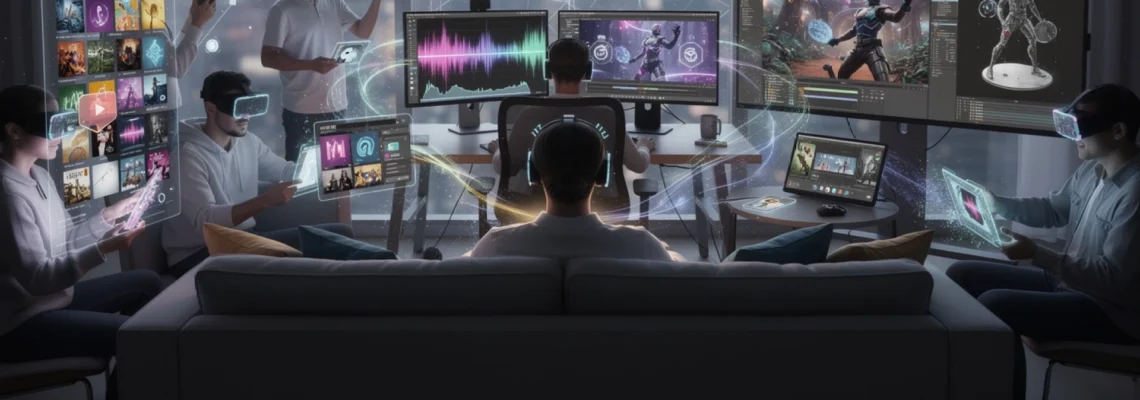
The digital revolution has fundamentally transformed how we consume, create, and interact with entertainment content. From algorithm-driven streaming platforms that anticipate our preferences to immersive virtual reality experiences that transport us to entirely new worlds, technology has redefined the very essence of leisure and creative expression. This transformation extends far beyond simple digitisation, encompassing sophisticated machine learning systems, blockchain-based ownership models, and artificial intelligence tools that democratise content creation.
Entertainment platforms now leverage complex algorithms and user data to deliver personalised experiences that were unimaginable just a decade ago. Interactive gaming technologies have evolved into photorealistic virtual environments, while user-generated content platforms have empowered millions to become creators rather than mere consumers. This shift represents a paradigm change in how entertainment functions as both an industry and a cultural force, fundamentally altering our relationship with media and creativity.
Streaming platforms and Algorithm-Driven content discovery mechanisms
Modern streaming platforms have revolutionised entertainment consumption through sophisticated algorithm-driven content discovery systems. These platforms utilise vast amounts of user data to predict preferences, optimise engagement, and create personalised entertainment experiences that adapt in real-time to individual viewing behaviours. The transformation from traditional broadcasting schedules to on-demand, algorithmically-curated content represents one of the most significant shifts in media consumption patterns.
The success of contemporary streaming platforms depends heavily on their ability to keep users engaged through intelligent content recommendation systems. These algorithms analyse viewing history, demographic data, device usage patterns, and even the time spent browsing different categories to build comprehensive user profiles. Content discovery has evolved from passive channel surfing to active algorithmic curation, fundamentally changing how audiences interact with entertainment media.
Netflix’s machine learning recommendation engine and user engagement metrics
Netflix’s recommendation algorithm processes over 130 million hours of viewing data daily, utilising collaborative filtering, content-based filtering, and matrix factorisation techniques to predict user preferences. The platform’s machine learning models consider factors such as viewing completion rates, time of day preferences, device usage patterns, and even the speed at which users scroll through content thumbnails. This sophisticated approach has resulted in an 80% content discovery rate through recommendations rather than search.
The platform’s A/B testing framework continuously optimises user interface elements, from thumbnail selection to content ordering, ensuring maximum engagement. Netflix’s algorithm considers micro-interactions such as pause duration, rewind frequency, and subtitle usage to refine its understanding of user preferences. These granular analytics enable unprecedented personalisation, creating unique viewing experiences for each of the platform’s 230 million subscribers worldwide.
Spotify’s collaborative filtering systems and personalised playlist generation
Spotify’s music recommendation ecosystem combines collaborative filtering with natural language processing and audio analysis to create personalised playlists that have redefined music discovery. The platform’s algorithm analyses user listening patterns, skip rates, and playlist creation behaviours alongside acoustic features extracted from audio tracks. This multi-dimensional approach enables Spotify to generate contextual playlists that match specific moods, activities, and temporal preferences.
The platform’s Discover Weekly feature, which delivers personalised playlists to 40 million users weekly, demonstrates the power of algorithmic curation in expanding musical horizons. Spotify’s recommendation engine processes over 4 billion playlists and considers factors such as lyrical content, tempo, and harmonic progression to identify songs that align with individual taste profiles. This sophisticated approach has increased user engagement and artist discovery rates significantly.
Youtube’s content delivery networks and Real-Time analytics integration
YouTube’s recommendation algorithm processes over 500 hours of video content uploaded every minute, utilising deep neural networks to analyse video content, user behaviour, and contextual factors. The platform’s machine learning models consider watch time, engagement metrics, video metadata, and user session patterns to optimise content delivery. YouTube’s algorithm prioritises videos that maximise total watch time rather than simple click-through rates, encouraging creators to produce more engaging content.
The platform’s real-time analytics integration enables immediate feedback loops between content performance and algorithmic recommendations. YouTube’s system analyses viewer retention graphs, comment sentiment, and sharing patterns to understand content quality and audience engagement. This comprehensive approach has resulted in over 1 billion hours of video consumption daily, with 70% of viewing time driven by algorith
-time recommendations.
As YouTube continues to refine its content delivery networks, latency reduction and adaptive bitrate streaming ensure smooth playback across varying connection speeds and devices. This technical backbone works hand in hand with real-time analytics to optimise not only what you see, but also how quickly and reliably you see it. The result is a highly responsive entertainment platform where audience behaviour, creator strategy, and algorithmic decisions are tightly interwoven in a continuous feedback loop.
Tiktok’s short-form video algorithm and dopamine-driven engagement loops
TikTok’s meteoric rise is largely attributable to its For You Page (FYP) algorithm, which prioritises content based on micro-engagement signals rather than follower counts. The platform tracks watch time down to the millisecond, replays, swipe-away speed, likes, comments, and shares to infer user interest. These signals feed reinforcement learning models that rapidly test and scale promising videos, enabling even new creators to go viral with a single post.
The short-form, full-screen format is optimised for dopamine-driven engagement loops. Each upward swipe delivers a new, highly tailored clip, creating a slot-machine-like effect where users anticipate the next rewarding hit of content. This continuous novelty, combined with personalised recommendations, can lead to extended viewing sessions far beyond initial user intention. From a leisure perspective, TikTok exemplifies how algorithmic entertainment can blur the line between casual browsing and habitual consumption, raising important questions about digital well-being and attention management.
Interactive gaming technologies transforming traditional entertainment models
Interactive gaming has evolved from simple 8-bit pastimes into complex, cinematic experiences that rival film and television in both scale and emotional impact. Modern game engines, virtual reality systems, and cloud infrastructure have transformed gaming into a central pillar of digital entertainment. This evolution is not just visual; it reshapes how we participate in stories, collaborate with others, and express creativity through play.
As gaming technologies become more immersive and accessible, traditional boundaries between passive viewing and active participation continue to erode. We are no longer just watching heroes on screen; we are inhabiting their worlds, making choices, and co-creating narratives with developers and other players. This shift towards interactive entertainment is redefining leisure as a deeply participatory, often social experience that can span devices, locations, and even realities.
Unreal engine 5’s nanite virtualised geometry and photorealistic rendering
Unreal Engine 5 represents a major leap forward in real-time graphics, particularly through its Nanite virtualised geometry system. Nanite allows developers to import film-quality assets with billions of polygons and render them in real time, automatically streaming and scaling detail based on camera distance. This means environments can feature unprecedented levels of detail without overwhelming hardware, enabling near-photorealistic worlds on consumer devices.
Combined with the Lumen global illumination system, Unreal Engine 5 delivers dynamic lighting and reflections that respond in real time to changes in the environment. For players, this creates virtual spaces that feel tangible and alive, dramatically enhancing immersion in interactive entertainment. For creators, these tools lower technical barriers, allowing smaller teams to produce AAA-quality experiences and experiment with new forms of digital storytelling and creative world-building.
Virtual reality platforms: meta quest pro and PlayStation VR2 immersive experiences
Virtual reality platforms such as Meta Quest Pro and PlayStation VR2 are redefining what it means to “enter” a game or experience. Equipped with high-resolution displays, inside-out tracking, and advanced haptic feedback, these headsets enable users to physically move, look around, and interact with digital environments in intuitive ways. The result is a level of presence that traditional flat-screen entertainment cannot match.
Meta Quest Pro leverages standalone processing and mixed reality capabilities, allowing digital objects to blend with your physical surroundings for both work and play. PlayStation VR2, tethered to the PlayStation 5, capitalises on console power to deliver graphically rich, story-driven VR titles with eye tracking and adaptive triggers. These immersive platforms transform leisure into embodied experience, where your gestures, gaze, and movement become integral to the narrative and gameplay rather than mere inputs on a controller.
Cloud gaming infrastructure: google stadia’s legacy and xbox game pass streaming
Cloud gaming has sought to decouple high-end interactive entertainment from expensive local hardware, instead rendering games on remote servers and streaming them to users over the internet. While Google Stadia ultimately shut down in 2023, its technical achievements—low-latency streaming, scalable data centres, and seamless device switching—have influenced the broader cloud gaming ecosystem. Stadia demonstrated that console-quality experiences could be delivered via browsers and mobile devices, provided the network conditions were sufficient.
Xbox Game Pass Ultimate and its cloud streaming component have built on this legacy, offering a subscription-based model where hundreds of titles can be played on consoles, PCs, and mobile devices. For players, this reduces upfront costs and friction in trying new games, much like streaming did for film and television. For the industry, cloud infrastructure opens new possibilities for cross-platform play, instant demos, and persistent game worlds that exist independent of any single device. As connectivity improves globally, cloud gaming is poised to become a cornerstone of on-demand digital entertainment.
Augmented reality integration in mobile gaming: pokémon GO and location-based entertainment
Augmented reality (AR) has brought interactive entertainment out of the living room and into the physical world. Pokémon GO, launched in 2016, remains the flagship example of location-based AR gaming, overlaying virtual creatures onto real-world environments via smartphone cameras and GPS. The game encourages players to explore their surroundings, visit landmarks, and collaborate in raids, turning entire cities into shared playgrounds.
This fusion of digital content with physical space has inspired a broader wave of AR-powered experiences, from scavenger hunts to city tours and brand activations. For many users, AR games provide a unique blend of exercise, social interaction, and casual play—redefining leisure time as both active and exploratory. By anchoring digital entertainment in real locations, AR highlights how technology can enhance, rather than replace, our engagement with the world around us.
User-generated content platforms democratising creative expression
User-generated content (UGC) platforms such as YouTube, TikTok, Twitch, and Instagram have fundamentally altered who gets to participate in entertainment creation. Instead of a small number of studios and broadcasters controlling distribution, millions of individuals now produce and share videos, streams, music, and art with global audiences. All you need is a smartphone and an internet connection to join the digital creative economy.
These platforms provide built-in editing tools, sound libraries, filters, and templates that lower the technical barriers to creation. Monetisation options—ad revenue sharing, tipping, brand partnerships, and subscriptions—offer viable income streams for successful creators. The result is a democratised entertainment landscape where niche interests, subcultures, and underrepresented voices can find dedicated communities, often bypassing traditional gatekeepers entirely.
However, this democratisation also introduces new challenges. Algorithmic visibility can create winner-takes-most dynamics, where a small percentage of creators capture the majority of attention and revenue. Content moderation, copyright enforcement, and mental health concerns linked to online visibility require ongoing attention from both platforms and users. For those looking to harness UGC platforms for creative expression, the key is to balance consistency and authenticity with healthy boundaries around time, privacy, and performance pressure.
Artificial intelligence tools revolutionising digital content creation
Artificial intelligence tools have become integral to modern digital content creation, enabling faster workflows, new creative possibilities, and personalised entertainment experiences at scale. From language models that draft scripts to generative image systems that create concept art in seconds, AI is transforming how individuals and studios alike approach the creative process. Rather than replacing human creativity, these tools often act as powerful collaborators, handling repetitive tasks and sparking new ideas.
As AI systems become more accessible through web interfaces and integrated software features, more creators can experiment with advanced capabilities that once required specialist skills. Yet with these opportunities come ethical and practical considerations: how do we ensure originality, respect intellectual property, and maintain transparency about AI involvement? Navigating this new creative landscape requires both technical literacy and thoughtful ethical frameworks.
Openai’s ChatGPT and GPT-4 language models in scriptwriting applications
Large language models such as OpenAI’s ChatGPT, built on the GPT-4 architecture, are increasingly used in scriptwriting, copywriting, and narrative design. Writers can prompt these models to generate dialogue, scene outlines, world-building details, or alternative endings, dramatically accelerating brainstorming and early drafting. For episodic content, AI can help maintain consistency in tone and character voice across long-running projects.
Used thoughtfully, ChatGPT becomes a collaborative partner rather than a replacement for human authors. You might, for example, generate multiple variants of a scene and then refine the best elements, or ask the model to propose twists that you adapt to fit your overarching vision. At the same time, responsible use involves fact-checking outputs, avoiding over-reliance that might flatten unique voice, and being transparent about AI assistance where relevant. In digital entertainment scriptwriting, AI thus functions as both accelerator and creative catalyst.
Adobe’s firefly AI image generation and photoshop neural filters
Adobe’s Firefly AI and Photoshop Neural Filters integrate generative capabilities directly into industry-standard creative tools. Firefly focuses on commercially safe image generation, trained on licensed and public domain content, enabling designers to create backgrounds, textures, and illustrative elements from text prompts. This is particularly valuable in pre-visualisation, marketing assets, and rapid iteration for digital entertainment campaigns.
Photoshop’s Neural Filters use machine learning to perform complex edits—such as relighting a portrait, adjusting facial expressions, or age progression—with just a few sliders. For creatives working on posters, key art, or social media assets, these tools compress hours of manual editing into minutes. By embedding AI into familiar workflows, Adobe lowers the learning curve and allows both seasoned professionals and emerging creators to experiment with advanced visual effects that once required specialist retouching expertise.
Midjourney and DALL-E 2 visual art creation workflows
Standalone generative image tools like Midjourney and DALL-E 2 have opened up new workflows for visual ideation and art production. Artists can input detailed prompts describing style, composition, and subject matter, then iterate rapidly on the generated outputs. This is particularly powerful for concept art, character design, and mood boards in game development, film production, and digital marketing.
Rather than replacing illustrators, many studios now use these systems as a starting point. Human artists curate, refine, combine, and paint over AI-generated images to align them with specific brand aesthetics and narrative needs. For independent creators, these tools can compensate for limited budgets or skills in certain areas, enabling more ambitious personal projects. As with all generative AI, however, questions around training data, artistic credit, and style mimicry must be carefully considered to ensure fair and respectful creative ecosystems.
Synthesia’s AI video generation and deepfake technology ethics
Synthesia and similar platforms enable the creation of AI-generated video avatars that can deliver scripted content in multiple languages and styles. For corporate training, explainer videos, or localisation of entertainment content, this technology dramatically reduces production time and cost. Instead of scheduling actors, cameras, and studios, creators can generate polished video segments from text alone, adjusting voice, appearance, and pacing on demand.
Yet these same underlying techniques power deepfake technology, which can be misused to create convincingly realistic but entirely fabricated videos. This raises serious ethical concerns around consent, misinformation, and reputation damage. As AI video generation becomes more sophisticated, entertainment professionals and platforms must adopt robust policies: watermarking AI content, obtaining explicit rights for likeness use, and educating audiences about synthetic media. In the digital age, responsible innovation means pairing technical possibility with clear ethical guardrails.
Blockchain technology and NFT integration in digital entertainment ecosystems
Blockchain technology has introduced new models for ownership, monetisation, and community engagement in digital entertainment. Non-fungible tokens (NFTs), built on blockchain standards like ERC-721, allow creators to issue unique or limited-edition digital assets—artworks, music tracks, virtual items—that can be bought, sold, and traded with verifiable provenance. For fans, owning an NFT can feel akin to holding a signed print or rare collectible, but with global liquidity and programmable features.
In gaming, blockchain-based assets enable player-owned economies where in-game items can move between platforms or be traded independently of the publisher. Musicians and filmmakers are experimenting with NFT-backed releases that bundle exclusive access, behind-the-scenes content, or governance rights in fan communities. These experiments hint at a future where entertainment ecosystems become more decentralised, with audiences participating not only as consumers but also as stakeholders and co-creators.
That said, blockchain integration is not without controversy. Environmental concerns around energy-intensive proof-of-work networks, volatile asset pricing, and speculative bubbles have all drawn criticism. Regulatory uncertainty and security risks, such as smart contract exploits, add further complexity. For creators and audiences interested in NFT-based entertainment, a prudent approach involves favouring energy-efficient chains, focusing on genuine utility and community value, and treating speculative hype with caution. The long-term potential of blockchain lies less in quick profits and more in transparent, interoperable infrastructures for digital rights and revenue sharing.
Social media convergence with traditional entertainment distribution channels
Social media platforms have evolved from simple networking tools into powerful distribution channels that now sit alongside, and often ahead of, traditional broadcasters. Film studios, record labels, and TV networks increasingly premiere trailers, teasers, and even full episodes on platforms like YouTube, Instagram, and Twitter to capture attention where audiences already spend their time. Streaming services build hype through meme culture, live-tweeted events, and influencer collaborations, blurring the lines between marketing, fan engagement, and primary content.
Creators who start on social platforms are also crossing into traditional entertainment, securing book deals, TV shows, and film roles based on their online followings. At the same time, established actors, directors, and musicians use social media to maintain direct relationships with fans, bypassing older PR-driven models. This convergence creates a multidirectional flow of talent and content, where virality on TikTok can influence music charts, and a hit streaming series can spark massive social conversations that extend its cultural footprint.
For audiences, the practical impact is a more fragmented but also more interactive entertainment landscape. You might discover a new series via a meme, watch it on a streaming platform, discuss it on Twitter, and then join a live Q&A with the cast on Instagram—all within a few days. For creators and brands, success increasingly depends on understanding how to orchestrate these touchpoints across channels, respecting platform cultures while maintaining coherent storytelling. As social and traditional media continue to intertwine, the future of leisure and creativity will likely be defined by this constant interplay between screens, communities, and ever-evolving forms of participation.