
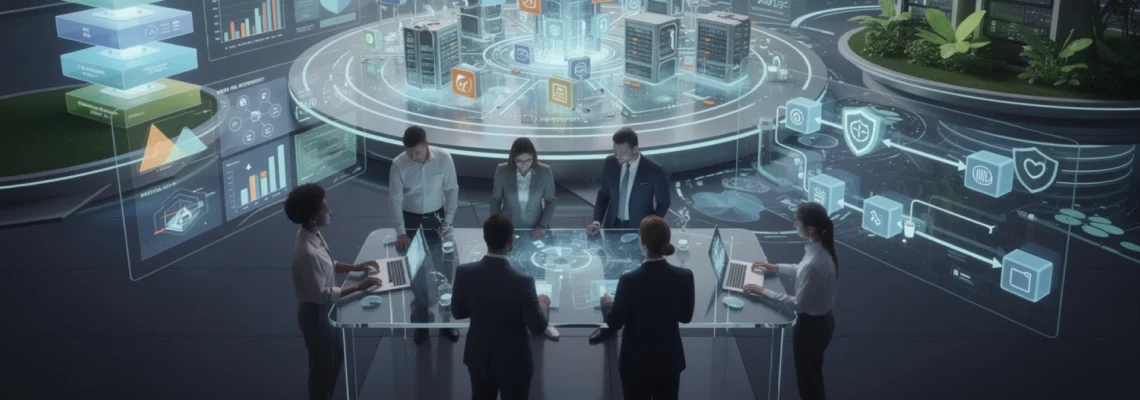
The digital transformation landscape has reached a critical juncture where sustainability and technological advancement must converge. Organizations across industries are recognizing that their digital infrastructure evolution cannot exist in isolation from environmental responsibility. Modern enterprises face mounting pressure to deliver innovative solutions while simultaneously reducing their carbon footprint and optimizing resource consumption. This challenge requires a fundamental shift in how we approach infrastructure planning, deployment, and management.
The concept of sustainable digital growth encompasses far more than simply reducing energy consumption. It involves reimagining entire technological ecosystems to support long-term organizational objectives while maintaining environmental stewardship. As data volumes continue to exponentially increase and cloud adoption accelerates, the environmental impact of digital infrastructure becomes increasingly significant. Organizations must therefore adopt holistic approaches that balance performance requirements with sustainability goals.
Infrastructure assessment and digital maturity evaluation frameworks
Effective infrastructure evolution begins with comprehensive assessment frameworks that evaluate both technical capabilities and sustainability metrics. Modern organizations require structured approaches to understand their current digital maturity while identifying opportunities for sustainable improvements. These assessment frameworks serve as the foundation for informed decision-making regarding infrastructure investments and modernization strategies.
TOGAF architecture development method for enterprise infrastructure analysis
The Open Group Architecture Framework (TOGAF) Architecture Development Method provides a systematic approach to enterprise infrastructure analysis that can be enhanced with sustainability considerations. This methodology enables organizations to create comprehensive architecture blueprints that incorporate both functional requirements and environmental impact assessments. The iterative nature of TOGAF allows for continuous refinement of architectural decisions based on evolving sustainability standards and technological capabilities.
When implementing TOGAF for sustainable infrastructure planning, organizations must integrate environmental impact assessments at each phase of the architecture development cycle. This involves evaluating energy consumption patterns, resource utilization metrics, and carbon footprint implications of proposed architectural changes. The Business Architecture phase should incorporate sustainability goals as core business drivers, while the Technology Architecture phase must consider green computing principles and energy-efficient technologies.
Digital maturity models: MIT CISR and gartner enterprise architecture frameworks
Digital maturity assessment requires sophisticated frameworks that can evaluate organizational readiness for sustainable transformation. The MIT Center for Information Systems Research (CISR) digital maturity model provides valuable insights into how organizations can leverage digital capabilities while maintaining sustainability focus. This framework emphasizes the importance of digital business transformation that aligns with environmental objectives and long-term sustainability goals.
Gartner’s Enterprise Architecture frameworks complement MIT CISR models by providing practical guidance for implementing sustainable digital initiatives. These frameworks help organizations identify areas where technological improvements can deliver both operational efficiency gains and environmental benefits. The assessment process involves evaluating current infrastructure capabilities, identifying modernization opportunities, and prioritizing initiatives based on sustainability impact and business value.
Technical debt assessment using SonarQube and CodeClimate metrics
Technical debt assessment plays a crucial role in sustainable infrastructure evolution by identifying inefficient code and system components that consume unnecessary resources. SonarQube and CodeClimate provide comprehensive metrics that help organizations quantify the environmental impact of technical debt while prioritizing remediation efforts. These tools enable development teams to understand how code quality directly affects system performance and energy consumption.
The relationship between technical debt and sustainability extends beyond immediate resource consumption to long-term maintainability and efficiency. Poor code quality often results in increased computational requirements, higher energy consumption, and reduced system lifespan. By implementing systematic technical debt assessment processes, organizations can identify opportunities to improve both code quality and environmental performance through targeted refactoring initiatives.
Legacy system integration complexity analysis with strangler fig pattern
Legacy system modernization presents unique challenges for organizations pursuing sustainable digital transformation. The Strangler Fig pattern offers an elegant approach to gradually replacing legacy systems while minimizing disruption and resource waste. This pattern allows organizations to incrementally migrate functionality from legacy systems to modern, more sustainable alternatives without requiring complete system replacement.
Implementation of the Strangler Fig pattern requires careful analysis of system interdependencies and resource consumption patterns. Organizations must evaluate which legacy components contribute most significantly to environmental impact and prioritize their replacement accordingly. The gradual migration approach reduces the risk of failed modernization projects while enabling continuous improvement in sustainability metrics throughout the transformation process.
Cloud-native architecture transformation strategies
Microservices migration patterns: database per service and API gateway implementation
Cloud-native transformation often begins with rethinking how applications are structured and how they consume infrastructure resources. Moving from monolithic applications to microservices enables teams to scale and deploy components independently, reducing over-provisioning and unnecessary compute usage. A well-designed microservices architecture supports sustainable growth by aligning infrastructure consumption with actual demand rather than peak-load assumptions.
The database per service pattern is central to sustainable microservices design. By giving each microservice its own data store, you reduce cross-team contention, simplify scaling strategies, and avoid running oversized, generic database clusters that waste energy. This approach also enables more granular performance tuning and lifecycle management, which can lower the overall infrastructure footprint. However, you must carefully manage data consistency, schema evolution, and reporting needs through patterns like event sourcing or CQRS to prevent hidden complexity and duplicated data growth.
An API gateway sits at the edge of your microservices landscape to provide a unified entry point for consumers and a control point for sustainability optimisations. Instead of each service independently handling authentication, rate limiting, and request shaping, the API gateway centralises these cross-cutting concerns. This allows you to throttle non-essential traffic during peak energy cost periods, cache frequently accessed responses, and route requests intelligently to the most efficient backend instances. Over time, this can significantly reduce redundant processing and network overhead while improving user experience.
When planning a microservices migration, organizations should avoid a “big bang” rewrite. Start by carving out high-impact domains from the monolith, especially those that are resource intensive or change frequently. By monitoring the infrastructure usage of these newly independent services, you can refine your database per service strategy and API gateway policies. This incremental approach mirrors the Strangler Fig pattern and helps you align microservices adoption with measurable sustainability and performance improvements.
Container orchestration with kubernetes and docker swarm for scalability
Containers are at the heart of modern digital infrastructure, enabling consistent deployment and efficient resource sharing across environments. Orchestration platforms like Kubernetes and Docker Swarm automate the placement, scaling, and lifecycle of containers, and when configured correctly, they become powerful tools for sustainable infrastructure management. Rather than running static, always-on virtual machines, you can dynamically adjust container density and node utilisation to match real-time demand.
Kubernetes offers fine-grained control over resource requests and limits, enabling you to prevent both resource starvation and wasteful over-allocation. Features such as cluster autoscaling and horizontal pod autoscaling help you elastically adjust capacity, so your cluster runs close to optimal utilisation. When combined with node pools tuned for different workloads, you can route batch jobs, latency-sensitive services, and development environments to the most appropriate and energy-efficient compute resources. This is similar to using different vehicles for different journeys rather than driving a heavy truck for every short trip.
Docker Swarm, while simpler, can still support sustainable growth for smaller or less complex environments. Its straightforward clustering model and declarative service definitions make it easier for teams at earlier stages of digital maturity to adopt container orchestration. By defining resource constraints and carefully planning node sizes, Swarm clusters can minimise idle capacity and simplify operations. Over time, organizations may choose to transition from Swarm to Kubernetes as their needs for multi-tenant governance, advanced scheduling, and policy control grow.
Regardless of the orchestration platform, observability and capacity planning are essential. You should regularly analyse cluster utilisation, pod churn, and scaling patterns to identify opportunities for consolidation and right-sizing. Integrating cost and energy metrics into your dashboards helps teams connect deployment decisions to sustainability outcomes. With the right guardrails in place, container orchestration becomes a lever for both resilience and responsible use of digital infrastructure.
Serverless computing integration using AWS lambda and azure functions
Serverless computing extends the idea of on-demand infrastructure by abstracting servers entirely from the developer’s perspective. Services like AWS Lambda and Azure Functions execute code only when triggered, scaling automatically and charging based on actual usage. From a sustainability standpoint, this “pay-per-invocation” model can significantly reduce idle capacity and energy waste, especially for spiky or event-driven workloads.
When you integrate serverless into your architecture, you shift from long-running services to short-lived functions that spin up, execute, and shut down quickly. This is akin to switching from leaving lights on in every room to using motion sensors that only activate lighting when someone is present. Functions are particularly effective for tasks like data transformations, event routing, scheduled jobs, and low-traffic APIs that do not justify dedicated container or VM capacity. However, it is important to monitor cold start latencies and function execution times to ensure that energy savings do not come at the cost of poor user experience.
A sustainable serverless strategy requires careful design of function boundaries and dependencies. Over-fragmenting logic into too many small functions can increase overhead, network calls, and logging volumes, which may offset some of the efficiency gains. Grouping related operations into well-scoped functions and using asynchronous patterns where appropriate helps maintain a balance between modularity and performance. You should also apply robust lifecycle management practices, such as automatic cleanup of unused functions and regular review of timeout and memory settings.
Security and governance remain critical when adopting serverless platforms. Integrating functions into your existing IAM policies, monitoring, and DevSecOps pipelines ensures that rapid scaling does not introduce unmanaged risk. By combining serverless computing with event-driven design and strong observability, organizations can build digital solutions that automatically flex with demand and support sustainable digital growth without continuously expanding their server footprints.
Multi-cloud strategy implementation with terraform and ansible automation
As organizations pursue sustainable growth, multi-cloud strategies offer flexibility to optimise workloads across providers based on performance, cost, and environmental factors. Using platforms such as Terraform and Ansible, teams can define infrastructure as code and orchestrate deployments across AWS, Azure, GCP, and on-premises environments. This enables more granular control over where and how workloads run, making it possible to favour regions with cleaner energy mixes or lower carbon intensity.
Terraform provides a declarative model for provisioning cloud resources, which is particularly valuable when you want consistent, repeatable infrastructure deployments. By integrating sustainability criteria into Terraform modules—such as defaulting to energy-efficient instance types, managed services with strong PUE metrics, or regions with high renewable penetration—you encode sustainable choices into your baseline architecture. Over time, you can evolve these modules as providers publish more detailed environmental data and regional carbon reporting.
Ansible complements Terraform by handling configuration management, application deployment, and ongoing system changes. Automating patching, configuration drift corrections, and service restarts reduces manual intervention and the risk of misconfigured systems consuming excess resources. When combined with dynamic inventories and tags that represent sustainability attributes, Ansible playbooks can apply different optimisation profiles depending on workload criticality, geographic region, or time of day.
A multi-cloud approach also helps mitigate resilience risks linked to climate change and energy constraints, such as data centre outages due to heatwaves or regional power shortages. You can design failover strategies that not only maintain availability but also consider the environmental implications of backup locations. However, multi-cloud complexity must be managed carefully; without strong governance and cost visibility, duplicated services and orphaned resources can increase both spend and carbon footprint. Infrastructure automation with Terraform and Ansible is therefore essential to keep multi-cloud environments lean, compliant, and aligned with sustainability goals.
Event-driven architecture using apache kafka and RabbitMQ message brokers
Event-driven architecture (EDA) plays a crucial role in aligning digital infrastructure with real-time business needs while avoiding constant polling and unnecessary workload execution. Platforms like Apache Kafka and RabbitMQ enable systems to react to events as they occur, reducing the need for long-running processes that periodically scan for changes. Instead of repeatedly checking a database or service, components subscribe to streams of events and process them only when relevant information is available.
Apache Kafka is particularly well suited for high-throughput, distributed event streaming, where large volumes of data need to be ingested, processed, and analysed. By centralising event logs and enabling consumer groups to read at their own pace, Kafka decouples producers and consumers, which supports independent scaling. This decoupling allows you to optimise resource usage for each consuming service, scaling heavy analytics workloads separately from lightweight notification handlers. When tuned correctly, Kafka clusters can handle massive data flows with efficient use of CPU, memory, and storage.
RabbitMQ, with its flexible routing and reliable message queuing, is often used for task distribution, command processing, and integration between heterogeneous systems. It helps ensure that workloads are executed only when required and that failed tasks can be retried without manual intervention. This reduces operational overhead and prevents overprovisioning of worker services that would otherwise remain idle while waiting for new tasks. The combination of durable queues, acknowledgements, and back-pressure mechanisms helps maintain a sustainable balance between input rates and processing capacity.
Adopting event-driven architecture requires a mindset shift from request-response thinking to stream-oriented design. You must define clear event schemas, governance rules, and retention policies to avoid uncontrolled growth of topics and queues that can inflate storage and processing demands. When done well, EDA allows you to build responsive, loosely coupled systems that scale elastically with business activity and use digital infrastructure in a more targeted, energy-conscious way.
Devsecops integration and continuous delivery pipeline optimisation
Integrating DevSecOps practices into your digital infrastructure evolution ensures that security, compliance, and sustainability are considered from the earliest stages of development. Continuous delivery pipelines become the backbone of this approach, orchestrating how code moves from commit to production. By automating build, test, security scanning, and deployment activities, you reduce manual intervention, minimise errors, and shorten feedback loops, all of which contribute to more efficient use of computing resources.
Optimised pipelines also help avoid wasteful practices such as unnecessary test runs, redundant builds, or over-provisioned staging environments. By monitoring pipeline performance and resource usage, you can identify steps that consume disproportionate compute or storage and refactor them for efficiency. In this way, DevSecOps is not just about speed and safety; it is a framework for ensuring that digital infrastructure supports sustainable growth without sacrificing governance or resilience.
CI/CD pipeline security with GitLab CI and jenkins SAST/DAST integration
Secure and efficient CI/CD pipelines are essential to managing the evolution of digital solutions at scale. Tools like GitLab CI and Jenkins enable teams to integrate security scanning directly into the build and deployment process, using static application security testing (SAST) and dynamic application security testing (DAST). By catching vulnerabilities early, you avoid costly and resource-intensive remediation in production, which can involve emergency patches, unplanned rollbacks, and duplicated environments.
In a sustainable CI/CD design, security scans are tuned to balance thoroughness with performance. For example, you might run lightweight SAST checks on every commit while reserving full DAST suites for pre-release stages or nightly builds. This tiered approach reduces redundant scanning and shortens pipeline durations without compromising risk management. You can also employ caching, parallelisation, and incremental scanning to ensure that pipelines use compute resources efficiently while still enforcing security standards.
Integrating security into the pipeline also supports a “shift-left” culture where developers receive rapid feedback on code quality and vulnerabilities. This reduces rework later in the lifecycle and encourages patterns that are both secure and performant. Over time, as teams internalise secure coding practices, the number of critical issues discovered by SAST/DAST should decline, further shortening pipeline times and reducing energy consumption associated with repeated full scans.
Infrastructure as code security scanning with checkov and terrascan
As organizations adopt infrastructure as code (IaC) to manage cloud-native environments, ensuring the security and compliance of IaC templates becomes essential. Tools like Checkov and Terrascan automatically scan Terraform, CloudFormation, Kubernetes manifests, and other templates for misconfigurations before they reach production. This proactive validation helps prevent insecure defaults, overly permissive access controls, and resource definitions that could lead to inefficient or non-compliant infrastructure deployments.
Embedding IaC scanning into your CI/CD pipelines ensures that every infrastructure change is evaluated against a consistent set of policies. This not only strengthens security posture but also reduces the need for manual reviews and late-stage remediation. For example, you can enforce rules that block the creation of unencrypted storage, disallow public-facing databases, or prevent oversized instance types in non-production environments. Each blocked misconfiguration represents a potential reduction in both risk and wasteful resource consumption.
Over time, policy-as-code libraries maintained in Checkov or Terrascan become living documentation of your organisation’s security and sustainability standards. You can version these policies, track exceptions, and refine them as cloud providers introduce new services and features. By treating IaC security as a continuous, automated process rather than a one-time audit, you support a culture where infrastructure evolution is both rapid and responsibly governed.
Container security hardening using twistlock and aqua security platforms
Containerised workloads require robust security controls to prevent vulnerabilities from propagating across your digital infrastructure. Platforms like Twistlock (now part of Prisma Cloud) and Aqua Security provide end-to-end container security, from image scanning and runtime protection to network segmentation and compliance reporting. By automating these capabilities, you reduce the likelihood of compromised containers consuming extra resources or causing outages that require extensive recovery efforts.
Image scanning is often the first step, identifying known vulnerabilities and misconfigurations in container images before they are deployed. Integrating scanning into your build pipeline ensures that only approved, hardened images reach production. You can enforce policies that block images with critical CVEs, outdated base layers, or unnecessary packages that increase the attack surface and resource footprint. This is similar to inspecting vehicles before they join a fleet, ensuring each one is safe, efficient, and fit for purpose.
Runtime protection extends security controls into the operational environment. Twistlock and Aqua can monitor container behaviour, detect anomalies, and enforce least-privilege policies for processes and network communications. By preventing unauthorised activities and limiting resource-intensive exploits, these tools help keep your clusters stable and efficient. Fine-grained controls, such as limiting CPU and memory per container and enforcing secure runtime profiles, support both security objectives and sustainable infrastructure usage.
Automated compliance monitoring with chef InSpec and AWS config rules
Maintaining compliance with regulatory standards and internal policies becomes more complex as digital infrastructures scale across multiple clouds and regions. Tools like Chef InSpec and AWS Config Rules automate compliance checks, turning what used to be manual, periodic audits into continuous, low-friction processes. This not only reduces operational overhead but also enables faster remediation of drift from desired states.
Chef InSpec uses human-readable tests to define compliance requirements for servers, containers, and cloud resources. These tests can be executed as part of CI/CD pipelines or scheduled scans, providing clear pass/fail results and remediation guidance. By codifying compliance expectations, you ensure that new infrastructure aligns with security and sustainability standards from day one. For instance, tests might verify that logging is enabled, encryption is enforced, and unnecessary services are disabled to minimise both risk and resource usage.
AWS Config Rules operate within the AWS environment to monitor resource configurations continuously. When a resource drifts from the approved configuration—such as an S3 bucket becoming publicly readable or an EC2 instance lacking appropriate tags—Config can flag the issue or trigger automated remediation workflows. This real-time compliance monitoring helps prevent misconfigurations from persisting and consuming additional resources or violating governance policies. Together, InSpec and Config enable a governance model where compliance is embedded into day-to-day operations rather than treated as a separate, disruptive exercise.
Data architecture modernisation for sustainable analytics
Modern data architectures must support growing volumes, velocities, and varieties of data while remaining efficient and environmentally responsible. Traditional, monolithic data warehouses often require large, always-on clusters that are expensive to maintain and prone to overprovisioning. In contrast, cloud-native data platforms, data lakes, and lakehouse architectures can scale more flexibly, enabling you to align compute and storage consumption with actual analytics workloads.
A sustainable data strategy starts with classifying data by business value, retention needs, and access patterns. Frequently accessed operational data might reside in high-performance storage, while archival or compliance data can be moved to lower-cost, lower-energy tiers. Implementing lifecycle policies and automated tiering ensures that cold data does not occupy premium storage indefinitely. This is similar to organising a library where popular books are on the front shelves and less-used volumes are stored in the archive, accessible but not consuming prime space.
Decoupling storage and compute, a hallmark of many modern data platforms, further supports sustainable analytics. You can scale query clusters up or down based on demand, pause them during off-peak periods, and use serverless query engines for ad-hoc analysis. At the same time, data engineers should adopt efficient processing frameworks and avoid unnecessary data duplication, excessive logging, or over-granular partitioning that inflates storage and compute requirements. Good data modelling and governance practices are therefore as important to sustainability as they are to analytics quality.
Performance monitoring and observability stack implementation
To manage the evolution of digital infrastructures effectively, you need deep visibility into how systems behave across applications, infrastructure, and networks. An observability stack that combines metrics, logs, and traces allows you to detect performance issues early, diagnose their root causes, and optimise resource allocation. Without this visibility, teams may respond to performance complaints by simply adding more capacity, which can drive up both costs and environmental impact.
Implementing tools such as Prometheus, Grafana, OpenTelemetry, and centralised logging platforms creates a feedback loop between infrastructure behaviour and design decisions. For instance, you can identify microservices that consistently exceed their resource requests, find inefficient queries that cause CPU spikes, or spot underutilised nodes that could be consolidated. By acting on these insights, you can right-size deployments, tune auto-scaling thresholds, and retire redundant services. Over time, observability becomes the compass that guides sustainable optimisation rather than reactive scaling.
Effective observability also supports SLO-based operations, where teams define clear service level objectives for latency, error rates, and availability. When SLOs are met with headroom, you might experiment with reducing reserved capacity or relaxing scaling rules; when they are breached, you investigate whether the solution is code optimisation rather than more hardware. This disciplined approach avoids the common trap of masking software inefficiencies with additional infrastructure, which is both costly and environmentally unsustainable.
Green computing initiatives and carbon-neutral infrastructure design
Embedding green computing principles into your infrastructure strategy is essential for achieving long-term, sustainable growth. This involves designing systems that minimise energy consumption, prioritise efficient hardware, and leverage renewable energy sources wherever possible. Many cloud providers now publish region-level carbon data and offer carbon-aware load balancing options, enabling you to choose locations and services that align with your organisation’s climate commitments.
Carbon-neutral infrastructure design extends beyond data centre location to include hardware lifecycle management, e-waste reduction, and circular economy practices. For on-premises environments, this might involve consolidating servers onto more energy-efficient platforms, using advanced cooling technologies, and participating in equipment refurbishment or recycling programmes. In cloud-native environments, you can pursue carbon neutrality by selecting providers with strong renewable energy portfolios, using managed services that share infrastructure efficiently, and decommissioning underutilised resources promptly.
Ultimately, sustainable digital infrastructure is a cross-functional responsibility that spans architecture, operations, security, procurement, and governance. By combining assessment frameworks, cloud-native transformation, DevSecOps practices, modern data architectures, observability, and green computing initiatives, you create a virtuous cycle of continuous improvement. Each optimisation, no matter how small, contributes to a more resilient, efficient, and environmentally responsible digital ecosystem that can support your organisation’s ambitions for years to come.