
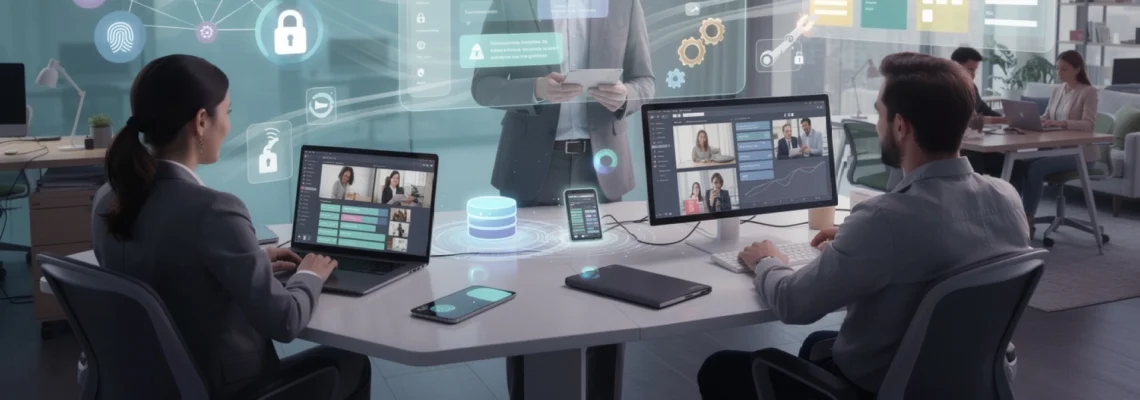
The workplace has undergone a fundamental transformation that extends far beyond simply moving from office cubicles to home desks. Today’s digital work environment represents a complete reimagining of how, when, and where professional tasks are accomplished. This shift encompasses everything from sophisticated cloud infrastructure to artificial intelligence-powered automation, creating unprecedented opportunities for flexibility and efficiency. Organizations that successfully navigate this transformation are discovering that technology serves not merely as a replacement for traditional processes, but as a catalyst for entirely new ways of thinking about productivity, collaboration, and professional fulfillment.
The convergence of advanced technologies, changing workforce expectations, and global connectivity has created a perfect storm for workplace evolution. Modern professionals now expect seamless digital experiences that rival consumer applications, while businesses demand measurable improvements in both operational efficiency and employee satisfaction. This dynamic has accelerated the adoption of sophisticated work technologies and methodologies that were once considered experimental or niche.
Remote work infrastructure technologies transforming modern workplaces
The foundation of modern remote work rests upon robust technological infrastructure that enables seamless collaboration regardless of geographical boundaries. Organizations investing in comprehensive remote work technologies are experiencing productivity gains of up to 35% compared to traditional office-based operations. This infrastructure revolution encompasses everything from cloud-based platforms to secure networking solutions, creating digital workspaces that rival physical offices in functionality while surpassing them in flexibility.
The most successful remote work implementations integrate multiple technological layers that work together harmoniously. These systems must provide not only basic connectivity but also sophisticated collaboration tools, security protocols, and performance monitoring capabilities. The key lies in creating an ecosystem where technology becomes invisible to users, allowing them to focus entirely on their work rather than wrestling with technical limitations.
Cloud-based collaboration platforms: microsoft teams and slack integration strategies
Modern collaboration platforms have evolved into comprehensive digital workspaces that integrate communication, file sharing, project management, and application access within unified interfaces. Microsoft Teams and Slack represent the leading edge of this evolution, offering sophisticated integration capabilities that connect with hundreds of third-party applications. Organizations implementing these platforms report communication efficiency improvements of 40-60% and significant reductions in email volume.
The strategic implementation of these platforms requires careful consideration of workflow patterns and user preferences. Successful deployments often involve creating custom channels and workspaces that mirror organizational structures while enabling cross-functional collaboration. Integration with existing business systems through APIs and webhooks creates seamless information flow that eliminates the need for constant application switching.
Virtual private network (VPN) solutions for secure remote access
Enterprise-grade VPN solutions have become the backbone of secure remote work infrastructure, enabling employees to access internal resources with the same level of security as on-premises connections. Modern VPN implementations utilize advanced encryption protocols and split-tunneling capabilities that optimize performance while maintaining security standards. Organizations deploying comprehensive VPN solutions typically see 99.9% uptime reliability and connection speeds that support even bandwidth-intensive applications.
The latest VPN technologies incorporate intelligent routing and load balancing that automatically optimizes connections based on user location and network conditions. These systems often include integrated threat detection and automated security responses that protect against emerging cyber threats without requiring manual intervention from IT teams.
Project management software: asana, monday.com, and trello implementation
Digital project management platforms have transformed how teams organize, track, and deliver complex initiatives across distributed workforces. Asana, Monday.com, and Trello each offer unique approaches to workflow visualization and task management, with implementation success rates exceeding 85% when properly deployed. These platforms typically reduce project completion times by 25-30% through improved visibility and accountability mechanisms.
The choice between different project management solutions often depends on team size, project complexity, and integration requirements. Larger organizations frequently benefit from platforms offering advanced reporting and resource management features, while smaller teams may prefer simpler, more intuitive interfaces that minimize learning curves and encourage adoption.
Video conferencing systems: zoom, google meet, and WebEx technical requirements
Professional video conferencing has evolved into a sophisticated communication medium that supports everything from small team meetings to large-scale webinars and virtual events. Modern platforms like Zoom, Google Meet, and WebEx offer advanced features including AI-powered noise cancellation, automated transcription, and intelligent camera framing. Organizations utilizing
high-quality video collaboration report that meetings feel more inclusive and efficient, with some organizations reducing travel costs by more than 60%. From a technical standpoint, stable high-definition conferencing generally requires at least 3–4 Mbps of symmetrical bandwidth per participant, along with devices that support modern codecs and hardware acceleration. IT teams should define baseline standards for cameras, microphones, and network quality of service (QoS) to avoid the all-too-common “Can you hear me now?” interruptions that still plague many digital workplaces.
Beyond bandwidth, successful deployment of Zoom, Google Meet, or WebEx depends on thoughtful integration with calendars, single sign-on (SSO), and room systems. Centralized administration, standardized meeting policies, and training on features like virtual backgrounds, breakout rooms, and recording governance help maintain a professional and secure environment. When video conferencing is treated as part of a broader remote work infrastructure rather than an isolated tool, it becomes a core driver of engagement and real-time collaboration across distributed teams.
Artificial intelligence and automation tools reshaping professional workflows
Artificial intelligence and automation have moved from buzzwords to practical tools that reshape how professional work gets done. Instead of replacing human workers wholesale, these technologies are increasingly used to augment human capabilities, eliminating low-value tasks and amplifying expertise. Organizations that deliberately rethink work in the digital age—by combining human strengths with AI-driven efficiency—are seeing measurable gains in throughput, accuracy, and employee satisfaction.
The key to harnessing AI and automation is to start with work design rather than technology selection. Which tasks are repetitive, rules-based, and high-volume? Which activities demand judgment, empathy, and creativity? By answering these questions, you can identify where machine learning, robotic process automation, and intelligent assistants can create the greatest impact while preserving a human-centric approach to work.
Machine learning applications in document processing and data analysis
Machine learning has become a cornerstone of modern document processing and data analysis, enabling organizations to handle information at a scale that would be impossible using manual methods. Intelligent document processing (IDP) solutions use optical character recognition (OCR) combined with machine learning models to extract, classify, and validate data from invoices, contracts, and customer correspondence with accuracy rates exceeding 95%. This significantly shortens cycle times in finance, legal, and customer service functions while reducing error rates and compliance risks.
In analytics, machine learning models are now routinely used for forecasting, anomaly detection, and pattern recognition across large data sets. Rather than spending hours cleaning spreadsheets and running static reports, analysts can focus on interpreting insights and advising the business. For example, predictive models can highlight which customers are most likely to churn or which supply chain nodes are at highest risk of disruption. When integrated into dashboards and business intelligence tools, these models transform raw data into actionable intelligence that informs daily decisions.
Robotic process automation (RPA) for repetitive task elimination
Robotic process automation acts like a digital workforce of software “bots” that carry out repetitive, rule-based tasks across systems. Common use cases include data entry between legacy systems, claims processing, order reconciliation, and routine HR transactions. According to industry benchmarks, well-designed RPA implementations can reduce manual effort for targeted processes by 50–70%, freeing employees to focus on work that requires human judgment or customer interaction.
However, RPA success depends on more than simply installing a tool and pointing it at inefficient workflows. Processes need to be standardized, documented, and simplified before they are automated; otherwise, you risk scaling chaos. A useful analogy is building a factory: you would not automate a production line until you know each step is necessary and optimized. The same principle applies to digital workflows—organizations that pair RPA with thoughtful process redesign see the highest returns on investment.
Ai-powered scheduling and resource allocation systems
AI-powered scheduling and resource allocation systems are quietly transforming how organizations match work to people. Instead of relying on static rosters and manual planning, intelligent engines consider constraints such as skills, availability, time zones, regulatory limits, and workload balance to propose optimal schedules. In contact centers, for example, AI-driven workforce management tools can align staffing levels to predicted call volumes, improving service levels while reducing overtime costs.
For project-based work, AI-enhanced resource allocation can suggest the best mix of team members for a given initiative based on expertise, historical performance, and current commitments. This not only improves project outcomes but also supports fairer workload distribution and better talent development. When you think of scheduling as an advanced optimization problem rather than a calendar exercise, AI becomes an indispensable partner in creating more flexible and efficient ways of working.
Natural language processing tools for content generation and communication
Natural language processing (NLP) tools now support a wide range of content and communication tasks, from drafting emails and reports to summarizing meetings and analyzing sentiment. AI-powered writing assistants can suggest structure, improve clarity, and adapt tone to different audiences, allowing knowledge workers to produce higher-quality documents in less time. Automated transcription and summarization tools transform long video calls into searchable notes and action items, making it easier for teams to stay aligned across time zones and schedules.
At the same time, NLP is increasingly used to power chatbots and virtual assistants that handle routine inquiries from employees and customers. When designed thoughtfully, these systems provide instant responses to common questions while escalating complex issues to human agents. The result is a more scalable support model where humans focus on nuanced conversations and relationship-building, while machines manage repetitive communication at scale. As with other AI tools, the most effective deployments are transparent about where automation is used and keep humans firmly in the loop for oversight and improvement.
Agile work methodologies and digital transformation frameworks
Beyond specific tools, the digital age demands new ways of organizing and managing work. Agile methodologies—originally developed in software development—have now spread to marketing, HR, operations, and beyond as organizations seek greater flexibility and faster iteration. At their core, agile practices emphasize small, cross-functional teams, short feedback cycles, and continuous improvement, all of which align closely with the realities of remote and hybrid work.
Digital transformation frameworks, such as SAFe, OKR-driven operating models, or McKinsey’s three-horizon model, provide structure for scaling agility across large enterprises. They encourage organizations to move away from rigid, top-down planning toward more adaptive portfolios of initiatives that can be re-prioritized as conditions change. The most successful companies combine agile practices with clear strategic direction, ensuring that empowered teams still pull in the same overall direction rather than creating fragmented efforts.
Cybersecurity protocols for distributed digital workforces
As work becomes more distributed and devices multiply, cybersecurity moves from being a back-office concern to a strategic enabler of flexible work. A single compromised endpoint or weak password can undermine even the most sophisticated digital workplace. For this reason, modern security strategies focus less on hardening a single corporate perimeter and more on protecting every user, device, and application, wherever they are located.
Adopting robust cybersecurity protocols is not only about compliance; it is about preserving trust in digital ways of working. Employees must feel confident that remote access, cloud collaboration, and AI-powered tools do not expose them or their customers to unnecessary risk. When organizations embed security into work design from the outset—rather than treating it as an afterthought—they create a safer foundation for ongoing innovation.
Zero trust network architecture implementation for remote teams
Zero Trust Network Architecture (ZTNA) has emerged as a key approach for securing remote teams in a world where “inside the network” no longer means “trusted.” Instead of granting broad access based on location or VPN connection, zero trust assumes that every access request may be hostile and validates each one continuously. This involves verifying user identity, device health, and context before granting granular access to specific applications or data.
For distributed digital workforces, zero trust can feel like moving from a single castle wall to a system of secure rooms and personalized keys. Employees access only what they need, when they need it, and anomalous behavior triggers rapid investigation. Implementing ZTNA typically requires a mix of identity providers, secure access service edge (SASE) platforms, and micro-segmentation strategies. While the transition can be complex, the payoff is a security model that aligns far better with cloud-based, location-independent work.
Multi-factor authentication systems and biometric security solutions
Multi-factor authentication (MFA) has become a baseline requirement for any organization serious about securing digital work. By requiring users to present two or more factors—such as something they know (a password), something they have (a token or phone), or something they are (biometrics)—MFA dramatically reduces the risk of account takeover. Industry studies suggest that MFA can block over 99% of automated attacks that rely on stolen or weak passwords.
Biometric security solutions, such as fingerprint or facial recognition, are increasingly integrated into laptops and mobile devices, providing a smoother user experience than one-time codes alone. When combined with adaptive authentication—where riskier activities trigger stronger verification—these tools strike a balance between security and usability. The goal is not to overwhelm employees with constant prompts but to make secure behavior the path of least resistance in day-to-day digital work.
Endpoint detection and response (EDR) tools for device management
With employees working from home networks, coworking spaces, and mobile hotspots, endpoints have become one of the most vulnerable elements in the security chain. Endpoint Detection and Response (EDR) tools provide continuous monitoring, threat detection, and automated remediation across laptops, phones, and tablets. Rather than relying solely on traditional antivirus signatures, modern EDR systems use behavioral analysis and machine learning to identify suspicious activity in real time.
From a practical standpoint, EDR enables IT and security teams to see what is happening across thousands of distributed devices, isolate compromised endpoints, and roll back malicious changes quickly. This capability is essential when rethinking work in the digital age, where employees may install new apps, connect to unfamiliar networks, or use personal devices more frequently. By pairing EDR with clear device policies and user education, organizations can maintain strong security without resorting to overly restrictive controls that hinder productivity.
Data encryption standards and compliance requirements (GDPR, HIPAA)
Data encryption is a non-negotiable component of secure digital work, protecting sensitive information both at rest and in transit. Modern standards such as AES-256 for storage and TLS 1.2+ for network connections ensure that even if data is intercepted or devices are lost, the underlying information remains unreadable. Encryption should extend across laptops, mobile devices, cloud storage, and communication channels to create a consistent layer of protection.
At the same time, organizations must navigate a complex landscape of regulatory requirements such as GDPR in Europe, HIPAA in healthcare, and sector-specific data residency rules. Meeting these standards requires more than technical controls; it involves clear policies, consent mechanisms, breach notification processes, and regular audits. When teams understand not only what the rules are but why they exist, compliance shifts from being a bureaucratic hurdle to a shared responsibility for safeguarding customer and employee trust.
Performance analytics and digital productivity measurement tools
As work becomes increasingly digital and distributed, traditional measures of productivity—such as hours in the office or visible activity—lose their relevance. Instead, performance analytics tools help organizations understand how work actually gets done: which processes are efficient, where bottlenecks emerge, and how collaboration patterns influence outcomes. Properly applied, these insights support better decision-making about staffing, technology investments, and work design.
Modern platforms can aggregate data from collaboration tools, project management systems, and business applications to provide a holistic view of digital work. For example, leaders might see how long it takes for customer requests to move from intake to resolution, or how many handoffs occur before a document is approved. The goal is not to micromanage individuals, but to identify systemic friction and opportunities for improvement. A helpful analogy is using traffic data in a smart city: we care less about tracking each car and more about reducing congestion and improving flow for everyone.
To maintain trust, organizations should be transparent about what is being measured and why. Instead of covert monitoring, involve employees in interpreting the data and co-creating solutions. Ask questions such as: Are meetings too frequent or too long? Do certain teams face more interruptions than others? Are high-value activities getting enough focus time? When performance analytics are used to enhance well-being and outcomes rather than surveillance, they become a powerful enabler of flexible, high-performing digital workplaces.
Flexible work models: hybrid scheduling and location-independent operations
The convergence of remote work technologies, AI-driven workflows, and robust cybersecurity has made flexible work models not only possible but increasingly expected. Hybrid scheduling—where employees blend time in the office with remote work—has become the dominant model in many knowledge-based organizations. At the same time, fully location-independent operations are emerging in sectors ranging from software development to professional services, allowing organizations to tap into global talent pools and operate across time zones.
Designing effective hybrid and remote models requires more than letting people “work from anywhere.” You need clear guidelines around which activities benefit from in-person collaboration, how teams coordinate schedules, and what digital norms support inclusivity for remote participants. For example, many organizations adopt “remote-first” meeting practices—defaulting to video calls with shared digital whiteboards—even when some people are in the same room, to level the playing field. Others establish core collaboration hours across time zones while allowing flexibility outside those windows.
From an operational standpoint, location-independent work calls for standardized digital toolsets, documented processes, and outcome-based performance management. Instead of equating presence with productivity, leaders focus on deliverables, customer impact, and learning outcomes. This shift can feel uncomfortable at first—especially for managers accustomed to visual oversight—but it ultimately creates a more equitable and scalable way of organizing work. When thoughtfully implemented, flexible work models unlock access to diverse talent, reduce real estate costs, and give individuals greater agency over how they design their working lives.
As we rethink work in the digital age, the common thread across all these elements—technology infrastructure, AI and automation, agile methods, cybersecurity, analytics, and flexible models—is intentional design. When we treat work itself as something that can be continuously redesigned, rather than a fixed set of roles and routines, we open the door to greater flexibility, higher efficiency, and more meaningful professional experiences for everyone involved.